小三
China’s chip exports nearly double in Jan-Jul; ‘New new three’ products to fuel continued export growth_我的网站

A |
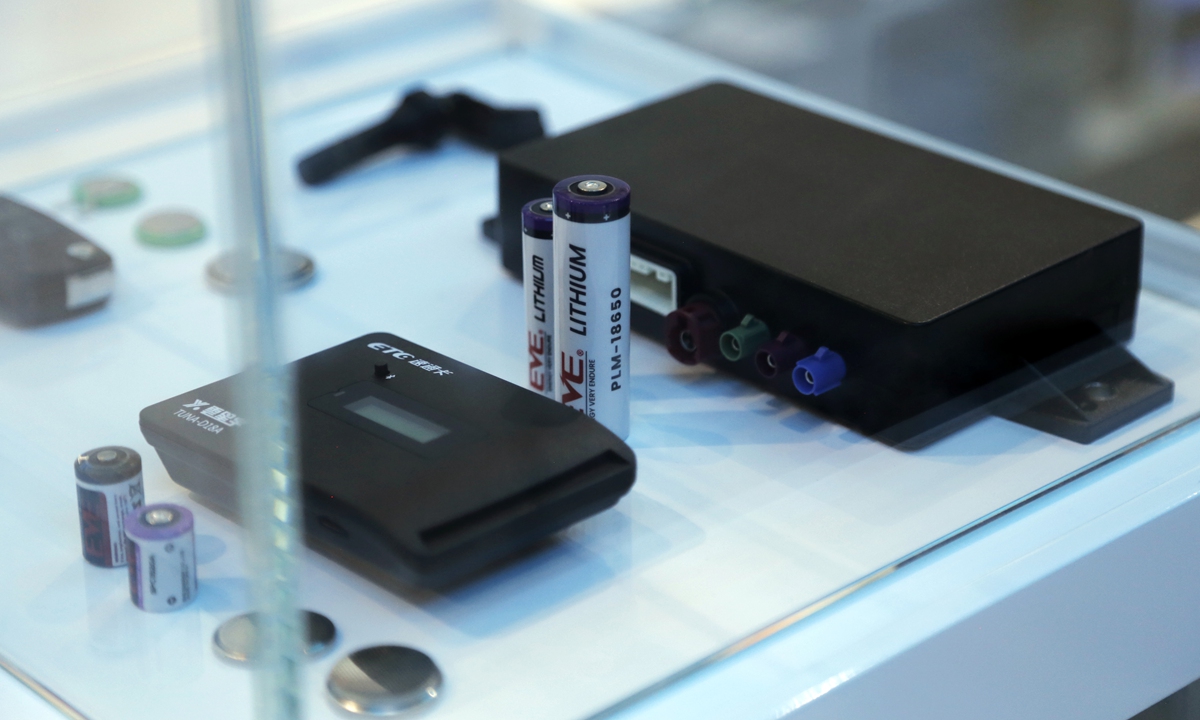
Different types of consumer lithium primary batteries on display Photo: VCGChinese researchers have developed a new high-energy lithium primary battery that can deliver both long-lasting energy and strong bursts of power while maintaining stable performance at temperatures as low as -40 C, Science and Technology Daily reported on Monday.
A research team led by Chen Zhongwei at the Dalian Institute of Chemical Physics under the Chinese Academy of Sciences developed a 25-ampere-hour pouch-type lithium-metal primary battery. Tests conducted by the safety laboratory of the China Electronics Standardization Institute showed that the battery achieved an energy density of more than 750 Watt-hour per kilogram at a low discharge rate, according to the report.
Meanwhile its discharge rate can be increased by up to 100 times, enabling short bursts of high-current discharge at 10C. The "C" stands for C-rate, which is the charge and discharge rates of a battery. According to sector website Battery University, the capacity of a battery is commonly rated at 1C, meaning that a fully charged battery rated at 1Ah should provide 1A for one hour. The same battery discharging at 0.5C should provide 500mA for two hours, and at 2C it delivers 2A for 30 minutes.
The new battery puts China among the world's leading players in high-power primary battery technology.
Primary batteries offer high specific energy, long storage times and instant readiness, allowing them to be used immediately even after long storage.
Primaries play an important role, especially when charging is impractical or impossible, such as in military combat, rescue missions and forest-fire services, the article said.
Traditional lithium primary batteries can store large amounts of energy for long periods, but their ability to rapidly release that energy can be limited. The new battery is designed to combine high energy density with high power output, allowing it to both operate for extended periods and provide large amounts of power when needed.
The battery can deliver short bursts of high-current discharge at up to 10C and sustain discharge at 4C. At room temperature, its specific power reaches 4,487 Watts per kilogram, according to Science and Technology Daily.
The battery also maintains strong performance under extremely cold conditions. At -40 C, the battery retains an energy density of 447 Watt-hour per kilogram at a 1C discharge rate. Its annual self-discharge rate is below 1 percent, meaning that it loses relatively little stored energy during long periods of standby.
Such characteristics could make the battery suitable for equipment that needs both long-term energy storage and sudden high-power output, including drones, robots, spacecraft and sensors deployed in remote areas.
Chen said the team achieved a breakthrough in cathode materials by developing a high-entropy oxide material and has established a pilot production line with an annual capacity of 10 tons, linking material development with battery-cell production.
The battery has passed third-party testing and is now undergoing further validation for applications including drones, robots, spaceflight simulators and field sensor nodes, according to Chen.
Global Times
。
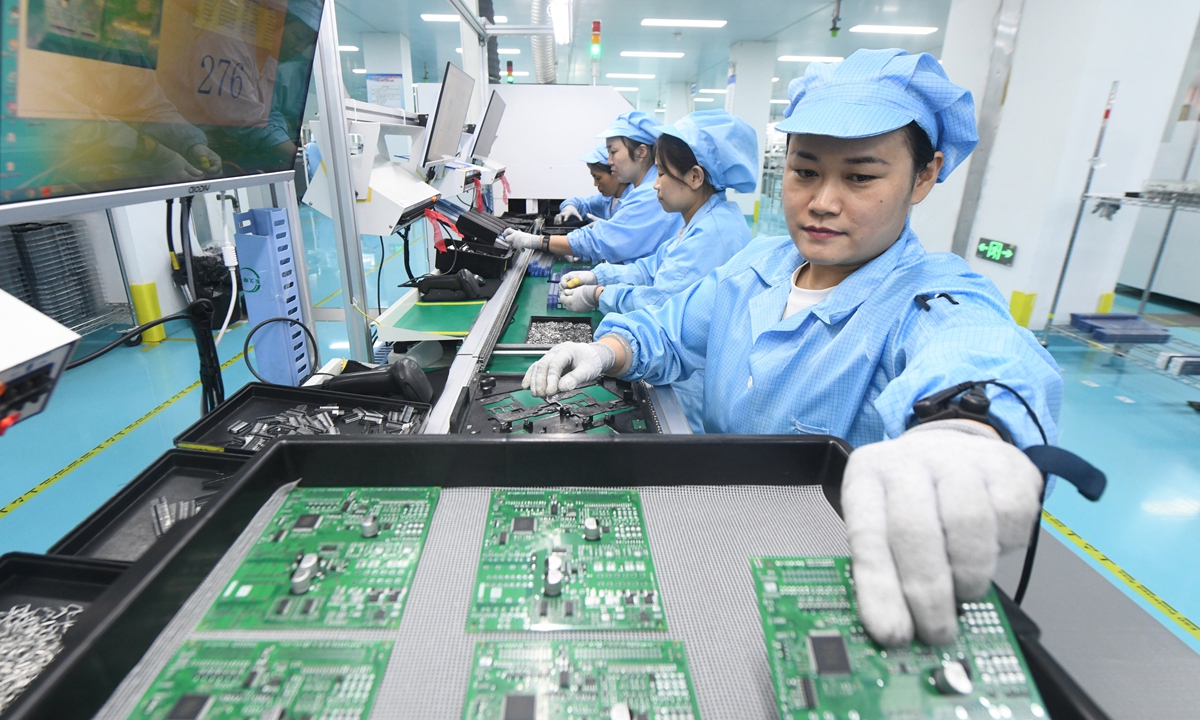
Workers produce electronic components for exports at a factory in Xinle, North China's Hebei Province, on June 16, 2026. Photo: VCG
China's exports of integrated circuits (ICs) reached $216.02 billion in the first seven months of 2026, up 99.5 percent year-on-year, according to data released by the General Administration of Customs (GAC) on Friday.
Chinese experts said that rising global artificial intelligence (AI) demand is a factor, but the main drivers of the leap in chip exports are the country's technological breakthroughs and upgraded industrial chain.
The robust growth in IC exports also came as China's overall foreign trade saw stable expansion. According to data released by the GAC, the sound upward trend in China's foreign trade continued in July, with growth of 19.2 percent year-on-year to reach 4.66 trillion yuan ($686.26 billion), remaining above 4 trillion yuan for the fifth consecutive month.
In the first seven months of the year, total foreign trade in goods amounted to 30.13 trillion yuan, up 17.3 percent year-on-year, the data showed.
"Since the start of this year, China's economy has forged ahead against headwinds and moved toward innovation-driven, higher-quality development, providing strong underpinning for the growth of foreign trade," said Lü Daliang, an official with the GAC.
According to the GAC, China's exports of electromechanical products reached 11.12 trillion yuan between January and July, up 21.2 percent year-on-year. They accounted for 63.8 percent of the country's total exports, up 3.8 percentage points on a yearly basis.
There was notable progress in green and low-carbon products, with exports of electric vehicles (EVs) and lithium batteries rising by 71.2 percent and 35.8 percent, respectively, while exports of 3D printers soared by 110 percent, with industrial robots jumping 13.2 percent and ships 32.7 percent.
"The surge in China's chip exports reflects breakthroughs in multiple aspects," Fu Liang, a Beijing-based tech analyst, told the Global Times on Friday. Fu pointed to a rise in mature-node capacity, industrial and supply chain resilience, and scale production advantages of Chinese companies.
As demand for chips in automotive electronics, industrial control systems, and household appliances keeps rising, China-made mature-process chips - backed by reliable supply capability and strong cost-performance - have become an indispensable link in the global supply chain, Fu said.
Meanwhile, there has been an upgrade in China's chipmaking industry, such as the new chip design approach at Huawei based on the company's Tau Scaling Law, and the international competitiveness of China-made chips is expected to increase, supporting further growth in exports, the expert noted.
China recently issued a revised regulation on protection of IC layout-designs. Scheduled to take effect on October 15 this year, the regulation aims to strengthen the protection and application of layout-designs, and improve registration and management systems by elevating proven practices into regulations, while also aligning with relevant laws and international treaties.
These institutional upgrades are unfolding alongside broader efforts to expand domestic demand and open the Chinese market wider to the world. China has also accelerated imports in the first seven months of this year to promote a more balanced development of foreign trade. China has remained the world's second-largest import market for 17 consecutive years. In the first seven months of 2026, China's import growth outpaced export growth by 8 percentage points, according to the GAC.
In addition, China's imports and exports with over 180 countries and regions registered growth over the period. Specifically, the country's trade with ASEAN, the EU, Latin America, and Africa rose by 20 percent, 9.5 percent, 15.4 percent, and 18.9 percent year-on-year, respectively. Trade with the US, however, fell by 1.6 percent, with the decline narrowing by 2 percentage points compared with the first half of the year, according to the GAC.
Amid a complex external environment, China has leveraged its complete industrial chain to accelerate trade structure upgrading, driving brisk growth in both imports and exports, Wen Bin, chief economist of China Minsheng Bank, told the Global Times.
Although China's foreign trade sector still faces pressure in the second half of the year, Wen said the same fundamentals are still supporting China's export growth: the competitiveness of China's "new new three" products, the ongoing AI investment cycle, plus a raft of domestic risk-mitigation policies covering forex, fiscal and customs.
"China's export sector is projected to hold onto double-digit growth in the second half of the year," he said.
。
Current article:http://hke.cengzaodengchawonin.cyou/4oi/20260826/4470.html
Published on:00:00:00